 Add to Chrome
 Add to Firefox
 Add to Edge
Annotation-Informed Block-Sparse Bayesian Modeling for cis-Expression Prediction
May 30, 2026
Genotype-based cis-expression prediction depends on accurately modeling local regulatory architecture. We present block-sparse Bayesian sparse linear mixed model (bsBSLMM), an extension of Bayesian sparse linear mixed model (BSLMM) that incorporates linkage disequilibrium (LD)-block spike-and-slab sparsity and a transcription start site (TSS)-informed SNP inclusion prior. Across 23,098 genes from GEUVADIS European-ancestry lymphoblastoid cell lines, bsBSLMM retained more predictable genes than BSLMM, LASSO, BLUP, TIGAR elastic net, and TIGAR Dirichlet-process regression under matched evaluation criteria. Compared with BSLMM, bsBSLMM improved held-out prediction performance for most shared genes, with gains driven primarily by LD-block sparsity and further enhanced by the TSS-informed prior. Variants selected by bsBSLMM showed stronger enrichment in GM12878 DNase and H3K27ac regulatory regions than variants selected by BSLMM. In transcriptome-wide association study (TWAS) analysis, bsBSLMM recovered established inflammatory bowel disease signals, including IL23R, and identified additional genome-wide significant genes not detected by BSLMM. Independent validation in the Louisiana Osteoporosis Study reproduced the increased prediction yield across ancestries and recovered biologically relevant bone mineral density pathways in downstream TWAS and gene set enrichment analyses. These results demonstrate that incorporating LD-block structure and biologically informed SNP priors improves cis-expression prediction and enhances downstream TWAS discovery.

VLA-IAP: Training-Free Visual Token Pruning via Interaction Alignment for Vision-Language-Action Models
Mar 24, 2026Vision-Language-Action (VLA) models have rapidly advanced embodied intelligence, enabling robots to execute complex, instruction-driven tasks. However, as model capacity and visual context length grow, the inference cost of VLA systems becomes a major bottleneck for real-world deployment on resource-constrained platforms. Existing visual token pruning methods mainly rely on semantic saliency or simple temporal cues, overlooking the continuous physical interaction, a fundamental property of VLA tasks. Consequently, current approaches often prune visually sparse yet structurally critical regions that support manipulation, leading to unstable behavior during early task phases. To overcome this, we propose a shift toward an explicit Interaction-First paradigm. Our proposed \textbf{training-free} method, VLA-IAP (Interaction-Aligned Pruning), introduces a geometric prior mechanism to preserve structural anchors and a dynamic scheduling strategy that adapts pruning intensity based on semantic-motion alignment. This enables a conservative-to-aggressive transition, ensuring robustness during early uncertainty and efficiency once interaction is locked. Extensive experiments show that VLA-IAP achieves a \textbf{97.8\% success rate} with a \textbf{$1.25\times$ speedup} on the LIBERO benchmark, and up to \textbf{$1.54\times$ speedup} while maintaining performance \textbf{comparable to the unpruned backbone}. Moreover, the method demonstrates superior and consistent performance across multiple model architectures and three different simulation environments, as well as a real robot platform, validating its strong generalization capability and practical applicability. Our project website is: \href{https://chengjt1999.github.io/VLA-IAP.github.io/}{VLA-IAP.com}.
SpNeRF: Memory Efficient Sparse Volumetric Neural Rendering Accelerator for Edge Devices
May 13, 2025Neural rendering has gained prominence for its high-quality output, which is crucial for AR/VR applications. However, its large voxel grid data size and irregular access patterns challenge real-time processing on edge devices. While previous works have focused on improving data locality, they have not adequately addressed the issue of large voxel grid sizes, which necessitate frequent off-chip memory access and substantial on-chip memory. This paper introduces SpNeRF, a software-hardware co-design solution tailored for sparse volumetric neural rendering. We first identify memory-bound rendering inefficiencies and analyze the inherent sparsity in the voxel grid data of neural rendering. To enhance efficiency, we propose novel preprocessing and online decoding steps, reducing the memory size for voxel grid. The preprocessing step employs hash mapping to support irregular data access while maintaining a minimal memory size. The online decoding step enables efficient on-chip sparse voxel grid processing, incorporating bitmap masking to mitigate PSNR loss caused by hash collisions. To further optimize performance, we design a dedicated hardware architecture supporting our sparse voxel grid processing technique. Experimental results demonstrate that SpNeRF achieves an average 21.07$\times$ reduction in memory size while maintaining comparable PSNR levels. When benchmarked against Jetson XNX, Jetson ONX, RT-NeRF.Edge and NeuRex.Edge, our design achieves speedups of 95.1$\times$, 63.5$\times$, 1.5$\times$ and 10.3$\times$, and improves energy efficiency by 625.6$\times$, 529.1$\times$, 4$\times$, and 4.4$\times$, respectively.
A Privacy-Preserving Domain Adversarial Federated learning for multi-site brain functional connectivity analysis
Feb 03, 2025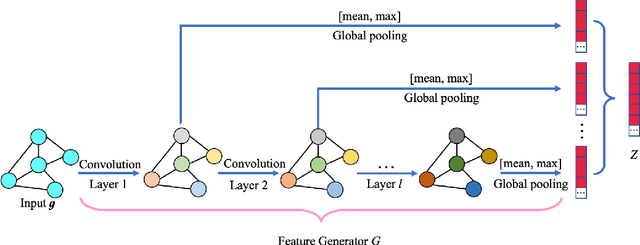
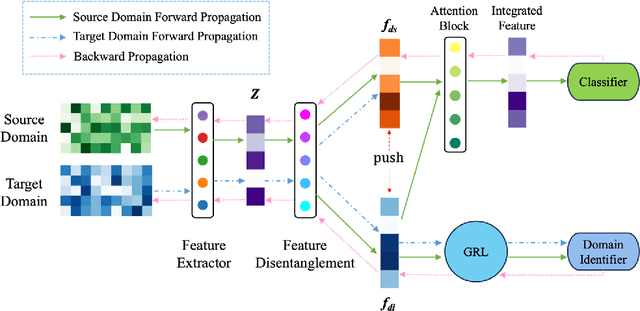
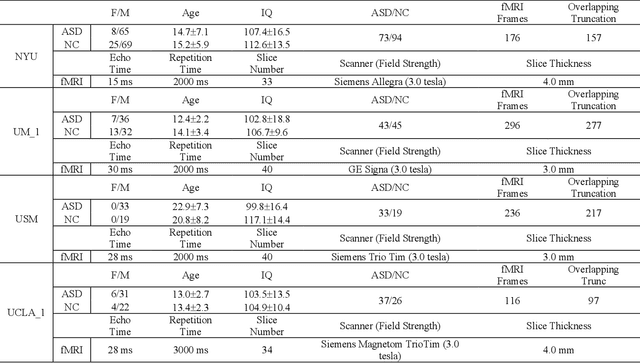
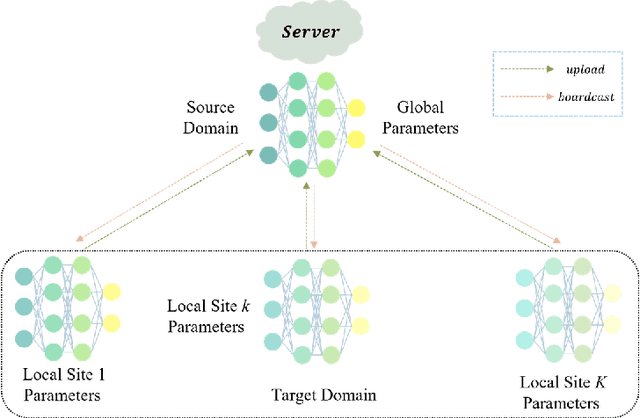
Resting-state functional magnetic resonance imaging (rs-fMRI) and its derived functional connectivity networks (FCNs) have become critical for understanding neurological disorders. However, collaborative analyses and the generalizability of models still face significant challenges due to privacy regulations and the non-IID (non-independent and identically distributed) property of multiple data sources. To mitigate these difficulties, we propose Domain Adversarial Federated Learning (DAFed), a novel federated deep learning framework specifically designed for non-IID fMRI data analysis in multi-site settings. DAFed addresses these challenges through feature disentanglement, decomposing the latent feature space into domain-invariant and domain-specific components, to ensure robust global learning while preserving local data specificity. Furthermore, adversarial training facilitates effective knowledge transfer between labeled and unlabeled datasets, while a contrastive learning module enhances the global representation of domain-invariant features. We evaluated DAFed on the diagnosis of ASD and further validated its generalizability in the classification of AD, demonstrating its superior classification accuracy compared to state-of-the-art methods. Additionally, an enhanced Score-CAM module identifies key brain regions and functional connectivity significantly associated with ASD and MCI, respectively, uncovering shared neurobiological patterns across sites. These findings highlight the potential of DAFed to advance multi-site collaborative research in neuroimaging while protecting data confidentiality.